Showing posts with label growing food. Show all posts

Sunday, October 17, 2010

Meyer Lemon

So this is the 2nd Meyer lemon tree I've purchased. The first one croaked on me pretty quickly. I think this is because I keep reading that they really don't like much water, and so I go a long time before giving it a good drench. Then the leaves start to fall off. Someday I will figure it out. I really want to have my own lemons (and limes).

The smell of the flowering trees is truly lovely.

Oh, and the goats like to eat citrus too. So several of the fruits on this tree were munched off. Looks like I have a whitefly or something too. Darn.

Anybody have any tips or experience out there?

Meyer lemon. Purchased spring 2010. 


See what else is growing in my garden.


__

Saturday, October 16, 2010

Blanching cardoon for harvest

I've never grown or eaten cardoon before. I noticed the other day that these plants are awfully large, so looked up the harvesting information. I had it in my head that I probably shouldn't harvest them this year... kinda like asparagus or rhubarb. But everything I've read seems to indicate that it is fine to harvest in the first year.

cardoon planted mid-summer
Blanched cardoon. Can't wait to try it in a few weeks!

These two articles are particularly interesting:
http://www.frenchgardening.com/aupotager.html?pid=11916664991580
http://subsistencepatternfoodgarden.blogspot.com/2009/10/forgotten-cardoon.html

Guy found some blackberries today. It makes him very happy.

See what else is growing in my garden.


___________________________

Oachita Blackberry

Oachita blackberry planted spring 2010. 
I purchased this variety as it is supposed to ripen very early in the season. Hoping to have fresh blackberries as long as possible. I bought this plant from Raintree, but it appears they aren't selling it anymore. The plant doesn't seem terribly happy, unlike the chester and triple crown blackberries that I planted. I'll update the blog next year to let you know what happens.

See what else is growing in my garden.


_____________________________________________

Himrod grapes

Himrod grapevine. Purchased from Raintree and planted spring 2010. 
I purchased this variety because it notes that it is a seedless and early ripening variety. I hope to make lots of raisins and have lots of fresh eating grapes.

See what else is growing in my garden.


____________________________________

Italian Alpine Strawberries

Italian Alpine strawberries. Grown from seed purchased from Territorial. 
As lovely as these little plants are, the flavor is very bland and they are mealy. I may even rip them out and try another variety. I was hoping for a variety that I could use in many areas that receive half shade.

View all of my recommendations here.


__________________________________

Friday, October 15, 2010

Pawpaw trees

These are the pawpaw trees that I planted in the spring. I have totally neglected them but thought that they would have performed better. Now I know from my tour at One Green World that they need a hefty dose of nitrogen. 

Mango pawpaw tree
Pennsylvania golden pawpaw tree

This is part of the series: What's growing in my garden


_______________
ZVP35X8H3QFY

Thursday, October 14, 2010

Trapping slugs with boards, tiles, rocks: here's what I've learned

If you haven't been following this experiment, let me write up a quick summary for you:

Trapping slugs is only minimally effective and is only that effective if you remember to go out every single day and check under every single trap. And you will only gather significant amounts of slugs if you place out very high numbers of traps.

Since slugs like to hide under boards, rocks, leaves, mulches, etc., I decided to try to see how effective it would be to trap them. I gathered every flat board, tile, and rock I could find and placed them under my slug infested bean plants, an area of roughly 50 square feet. I ended up with around 25 traps that covered at least a third of the infected area.

I had high hopes for this experiment. I thought that if I bombarded the area with traps, rather than place them randomly throughout the garden, I would have gained control rather quickly. Unfortunately that wasn't the case.

I kept the traps out for nearly two weeks, and I have collected and destroyed just as many slugs on the last day as I did on the first day. Initially I wanted to figure out just how long it would have taken me to gain control over the slug population in that area of the garden, but I am feeling now that the time I spend on flipping over ever single trap and destroying what is underneath is... well, not exactly a waste of time, as it obviously is mildly effective (IF you remember to go out everyday and destroy them) but I think my time would be better spent on another method of control.

While I was trying to gain control over the area, I was not oblivious to the fact that slugs were proliferating in every other area of my garden. I don't have time to trap every single slug and need to come up with a better approach.

Yesterday I had an aha moment when I was outside weeding. Weeding is one of the most effect methods of reducing slug populations since they won't have many shaded ground covers to hide under. I've got blackberries and all other manners of weeds trying to crowd out all of my vegetables. But I can't get anywhere fast with my little 3-4" hoe. I need a bigger hoe. The little hoe is still very useful for getting inbetween plants, but is going to take too darn long to hoe all my gardens with it. Also I am going to need to increase spacing of the plants, which will allow me to hoe easier.

Clearly I will need to do something about the current slug population. I will be experimenting with baits soon... how to use them most effectively. Stay tuned!


_______________________________________

Monday, October 11, 2010

Columnar Apple Trees

I have one of each of these columnar apple trees: Scarlet Sentinel, Golden Sentinel, Northpole.

All of these trees I've owned two years. I dug them up from the property my husband and I sold and brought them with me.

Some of them are starting to lean. I suppose I should put out stakes.

I've tasted fruit from both the scarlet and the golden sentinel, and both are good. They are bred to bear fruit early, so I think I may buy one more of each variety.

Golden Sentinel. 
Scarlet Sentinel. 
Northpole. 


This is part of the series: What's growing in my garden.


________________________________________________

Sunday, October 10, 2010

Tomato terminology

Here's a quick rundown on tomato lingo:

There's two main types of tomatoes to consider when cooking:
Plum, Sauce and Paste tomatoes refer to tomatoes that have a large amount of meat or flesh on the interior. These tomatoes are best for cooking into sauces as they won't break down into mostly water.
Slicer or beafsteak-type tomatoes refer to tomatoes that are best eaten fresh. When you cook they turn into mostly water rather than a sauce. They are very flavorful.

And there's two main types of tomatoes to consider when growing:
Determinate tomato varieties grow like a little bush. They will set a certain amount of fruit and then quit. People like to grow them because they are usually the first tomatoes of the season and if you need your tomatoes to be a little more confined.
Indeterminate grow on a vine that continues to grow and grow throughout the season. They can get very large and are best staked. Some people let them sprawl all over the ground, but I think its best to stake them in this climate due to the enormous slug population. The flavor of indeterminates tend to be better than indeterminate varieties and the yield can be higher. 


Okay, gardeners, anything I missed? 


____________________________________________

Saturday, October 9, 2010

One Green World nursery tour... part 2

Also see: One Green World nursery tour... part 1

This apple tree is showing signs of drought due to a gopher eating the roots. She showed us the gopher holes. I asked her how she could tell the difference between gophers and moles. She said that moles have the lines they dig up leading to their mole hills but the gopher lines aren't as evident. A gopher hill looks horseshoe-ish versus a little hill. Gophers will actually eat the root rather but the moles just make ugly lines and hills. She said that they've learned how to gas the gophers with sulpher which you can find out about through extension services.
Apple tree showing drought from gophers eating the roots.
Ushaped gopher mound. 
Gopher hole
The pawpaw is another underutilized fruit. It's biggest problem in this climate is slugs (imagine that). They need huge amounts of fertilizer, particularly nitrogen which is best done in the spring. They form a big taproot. They hate weeds... in fact they used some dutch white clover but it was far too agressive and became weedy. The pawpaw fruit will ripen on the counter if you pick it too early. The trees will probably start producing in their 3rd year if the tree was grafted. You can freeze the pulp and make it into a gelato, which I tasted and OMG that was good.
Pawpaw tree... some leaves show slug damage. 
More slug damage on a pawpaw leaf. 

The aronia berry is not for fresh eating. Trust me, I tried it. Yuck. But the berries are very high in anthocyanins, so it would be good for medicinal qualities. Also a very strong dye. It is a North American native.


Bird nesting is very effective for control of birds.

The Russian Olive grows in Eastern Oregon and is considered invasive.


Jujube


Autumn Olive... I think this is the right photo. At any rate, she said that the tree fixes its own nitrogen, has tasty berries that are high in licopene. Tasted like whisky to me. Must've been fermenting.


Seaberry--I found these to be very sour. There is a German variety which is very acidic and a Russian variety that is a little oily. It makes great juice with sugar. She said that she had juiced some russian berries and left it for awhile and a large amount of cream seperated out. That may be an interesting culinary experiment for someone... seaberry sorbet/ice cream?

I can't seem to find the right photo for the seaberry.

The Medlar is a funny looking fruit. When ripe, you open it up and it is like eating a little cup of applesauce. They ripen like a pear, from the inside out.
The Medlar

Callaway Crabapple Check out this beauty. Well, the photo doesn't do it justice. Anyway, she said it hasn't caught on at all and they will probably phase it out. Too bad cause it really is pretty. The fruit is actually decent eating and the tree was loaded with bright red cherry looking fruit. I want.


Callaway crabapple
So pretty! The fruits were even brighter in person.

Some miscellaneous tasting notes:


The Kew crapapple wasn't terribly interesting. It tasted a bit like a red delicious apple with a bit more flavor.


I don't even know what the azarole is but I wrote "blah" in my notes.

Didn't care for this mountain ash fruit. Maybe heavily sugared it would've been better. 
These are the two grape varieties I tasted that I would consider putting in the garden. 
The hardy kiwi tasted like a mellower commercial kiwi without the fuzz. Good.

This is what stole the show. The pawpaw gelato was crazy good. I wonder if they added much heavy cream?


Curious to see what I've got growing in my garden? 


_________

One Green World nursery tour... part 1

I just got back from the most interesting nursery tour. One Green World hosted a nursery tour and tasting of some of its unusual fruits. Here are some photos and lots of notes that I took along the way.

A disclaimer on my tasting notes: many of the items that are being sold as being unusual edibles, many of which are processed into preserves or fruit. For me, I am far more interested in having fresh fruit as many months out of the year as I can. So I have to admit that I ended up turning my nose at quite a few fruits that would taste good sugared and made into preserves or juice, but I feel that I need to steer clear of the sugared products. And I don't want to have to work too much.

If you are short on time, the most interesting of the unusual fruits to me were the pawpaws (which I already have), pineapple guava, astringent type persimmon, and the carraway crabapple.

First on our tour was the fig trees. The lady that was hosting the tour said that figs tend to grow very well in our climate (zone 8) but whether or not they ripen here is another question. She said that you want to make sure that the nursery that sells the tree has actually tasted fruit off the tree to verify that it is a variety that will produce fruit in this area. She said that Desert King is the absolute best variety for our region. Laturella is also a nice variety. Desert King is also frost resistant where most varieties are not.

More notes: She said that figs produce a summer crop and a fall crop. Most figs will produce both crops but you can buy varieties that will do only one or the other. Supermarket varieties suck if they haven't been ripened on the vine. The neck of the fig will droop when it is ripe. Kiwis bear fruit on wood that grew the previous year.

Desert King Fig.... roughly 8 years old. 
Laterella (sp?) fig. 

Next stop is the hazelnut, which is native to this area. Eastern hazelnut blight is a big problem, and the symptoms are shown in the photograph. There are varieties that are starting to come out that are blight immune. Cut out branches that are infected.
Hazelnut showing signs of hazelnut blight.

Large hazelnut tree.


The next specimen of interest is the Akebia vine. They are semi-evergreen. Not the choicest of edibles but has a very pretty bloom. She said that some are using akebias in place of peppers for stuffed peppers.

Semi-evergreen akebia vines. 

Closer pic of the akebia with kiwi growing through the middle. 
I definitely agree that akebias aren't the choicest of edibles. They tasted very blah to me and one tasted like mold.

Akebia tastings. 

Akebia fruit.
The next photo is of a Bayberry. All I remember her saying was that some use it in pilaf.
Bayberry
The next plant she talked about is a pineapple guava. She raved about this fruit, saying that the fruit is so good that she can't stop eating it. She says the flavor for her rates as high as a blueberry. Evidently there is a variety that is shipped from California to stores, and the Oregon ones taste much better. The pineapple guava ripes about the second week of December, but crops will suffer setbacks if there is a 25 degree or below spell. If that happens you can pick the fruit and it may ripen on the counter. She likes the variety Nikita. From a seedling, the plant will produce fruit in 3-7 years. Pollination can be an issue. Performs best in the sun but they do have plants that receive only half days of sun and they do produce fruit. Evergreen. They are from Southern Brazil. They have tart skin but the skin is edible. She prefers to peel the fruit. I think she sold me on this fruit.

Pineapple guava.
Pineapple guava. 
Beautyberry. Not edible but very pretty berries. Purple fruits stay on vine through mid feb. Can use in cut flower arrangements.

Beautyberry
This photo is a pallonia (sp?) tree. Value is mostly in the wood. Very warp resistant. 
Next in the orchard are the American Persimmons which are native to the east coast. The american persimmon is an astringent type persimmon, which means they have to be absolutely ripe before eating. Though they are an astringent variety, the astringency makes them more flavorful and sweet. They ripen in late October and won't last long. She says you can pulp and freeze the pulp. There is a book she talked about called "Dimple Green" (I think) that has useful persimmon recipes. You can take an unripe astringent persimmon and put it in a food dehydrator and it will lose its astringency. Leaves are sugar factories for fruit production. Once the leaves fall off, no more sugar will develop.

American persimmon roughly 25 years old.
 
An unripe American persimmon. 
The Asian Persimmon is a non-astringent type. It is deciduous and turns brilliant colors in the fall. The most popular fruit in the world is the persimmon, as there are so many persimmon trees in China. The persimmon is relatively disease resistant in this area unlike its native environment.

Asian persimmon. 

Unripe Asian Persimmon fruit
She's excited about this new growth on the persimmon. 

The Cornelian Cherry is a fruit you have to eat when completely ripe.
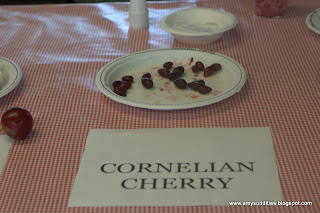


Tastings of the Cornelian Cherry. They are sooo sour. There were a few sauces made with them which weren't bad. 

This currant is showing signs of aphid damage, which looks like a fungal problem but isn't. Typically currants will ripen in July.
Currant


The Jujube or Chinese date will turn brown when ripe. The fresh texture is like an apple. Dried, it is truly very much like a date. There are some reported benefits of cholesterol reductions. Ripens mid-october and will keep for 1-2 months.
The Chinese Date or Jujube


The Chinese dogwood was bred for ornamental fruit. Pick when very red. They taste very blah to me. The "Julian" variety was the taste test winner.

Fruiting dogwood. 
Click here to see One Green World nursery tour... part 2.


______________________________________